01 · Quick profile
At a glance
M/M romanceTenderHealthy CommunicationFriends To LoversEmotionalComplex CharactersCharacter GrowthLikable Lead
4substantive sources
40grounded observations
9recurring signals
02 · Reader fit
Who this may suit
Try it if you want…
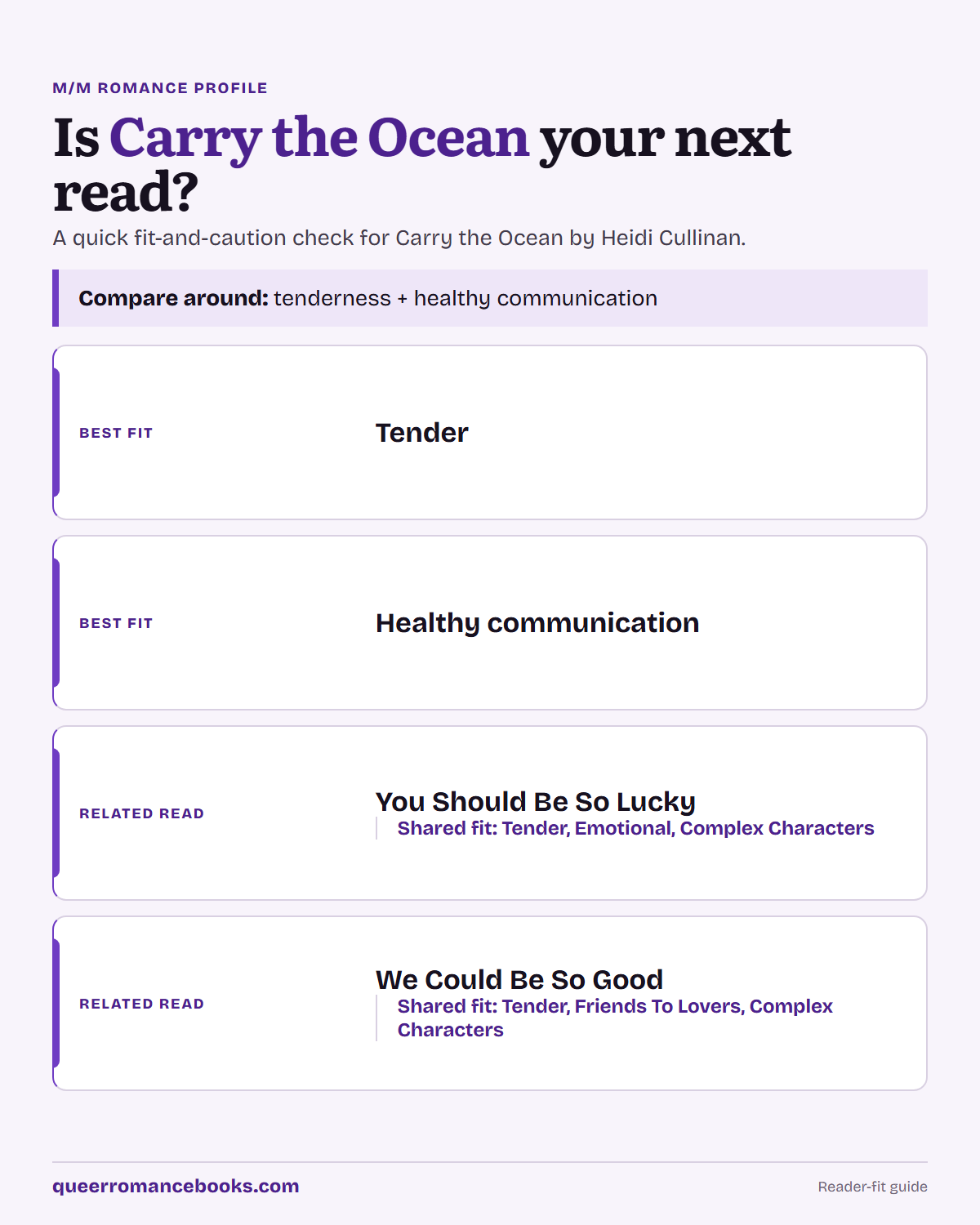
- You want tender
- You want healthy communication
- You want friends to lovers
Check before choosing if…
No additional fit cautions are available for this profile.
03 · Reader evidence
What the evidence says
What readers repeatedly liked
- Character Growth. Jeremey finally gets the help he needs through hospitalization, therapy, and medication, and learns to modify his environment; The book is praised as an exploration of both leads’ growth as individuals and as a couple, navigating challenges to arrive at a better place; The characters experience small victories and huge advancements as they fight for independence. Supported by 3 sources (source 1105, source 1107, source 1109).
- Complex Characters. The protagonists are portrayed as individuals with distinct experiences rather than monolithic representations of their conditions; Emmet is praised as feeling like a real person with autism, with specific struggles and traits that ring true; The autistic character is portrayed with sophisticated detail, showing unique coping strategies and individual quirks. Supported by 3 sources (source 1105, source 1107, source 1109).
- Healthy Communication. The protagonists develop communication codes and strategies, with Emmet suggesting modifications like typing when Jeremey cannot speak, and being direct about what works and what does not; Emmet’s directness means Jeremey always knows where he stands, and Emmet creates a letter-code system for when texting is too much for Jeremey; A reader exclaimed that the book demonstrates open communication at its finest. Supported by 3 sources (source 1105, source 1107, source 7285).
- Emotional. Reviewer describes the book as alternately poignant and painful, valuing these qualities; The novel depicts crippling anxieties and frustrations, creating an emotionally intense experience; The book made a reader cry for most of it yet left them feeling happy, balancing heavy content with really good highs. Supported by 3 sources (source 1107, source 1109, source 7285).
- Tender. Reviewer calls it a heartwarming story, though not always an easy read; The story is remarkably tender and illuminating. Supported by 2 sources (source 1107, source 1109).
- Likable Lead. The reviewer was charmed by Emmet and Jeremey, finding Emmet sweetly vulnerable and empathizing with their difficulties; Reviewer liked Emmet a lot, describing him as the best partner Jeremey could have. Supported by 2 sources (source 1105, source 1107).
- Emotional Intimacy. Their strengths complement each other’s needs; Emmet’s matter-of-fact acceptance is a blessing to Jeremey, and they understand each other’s strengths and shortfalls; The characters discover they want and need each other while exploring sex, lust, and love for the first time. Supported by 2 sources (source 1105, source 1109).
What readers repeatedly flagged
- Trauma. The book includes suicidal ideation and an attempted suicide, explicitly noted as a trigger warning; The story includes a very dark moment and depicts clinical depression reaching a critical breaking point. Supported by 2 sources (source 1105, source 1109).
Where reader reactions differ
The current sources did not support a recurring split that could be reported confidently.
Individual observations
- Flat Characters. Jeremey is criticized as feeling more like the sum of his disorders rather than a fully realized person, and at times the focus on his issues felt like an after-school special.
- Satisfying Ending. The happy ending is more believable because the book does not shy away from difficulties, and the reader finished feeling confident the characters would work through challenges together.
- Requires Darkness Tolerance. The novel contains a very dark moment and explores crippling anxieties and depression.
- Low Heat. Multiple readers found the book not particularly sexy and lacking in built-up sexual tension, though one reviewer felt the sweeter tone was appropriate for first love.
- Explicit Comparison. A commenter found Me Before You educated organically without feeling schooled, unlike this book where the author’s teaching presence was felt; A commenter found The Rosie Project fun and sexy without the author whispering, while another found Carry the Ocean a more accurate portrayal of ASD that does not gloss over challenges.
- Found Family. Emmet and his dad bond over The Blues Brothers and the circle expands to include Jeremey and later other Roosevelt residents.
- Strong Chemistry. The reviewer thought they had chemistry but it was not the main focus of the story, with little sexual tension because they were always clear they wanted to be together.
- Balanced Romance Plot. The reviewer enjoyed the coming-of-age aspects as much as the romance, and the relatively conflict-free romance suited the story because so much else was going on.
- Romance Forward. This is not standard m/m romance fare but rather focuses on how love can come into every life.
- Strong Plot. The book does not shy away from the problems and difficulties the characters face, and does not rely on a magical cure by love.
Reader sources
- dearauthor.com – Independent review
- allaboutromance.com – Independent review
- thenovelapproachreviews.com – Independent review
- Reddit discussion
04 · Keep reading
Books with a similar fit
Open the full Taste Transfer matcher05 · Trust note
How this page works
This book cleared the full Queer Romance Books evidence gate. Reader signals shown here come from stored full pages and paragraph-grounded observations; search snippets are never treated as evidence.
Read the methodologyAmazon link
See the current edition
No cover, price or rating is reproduced on this site.